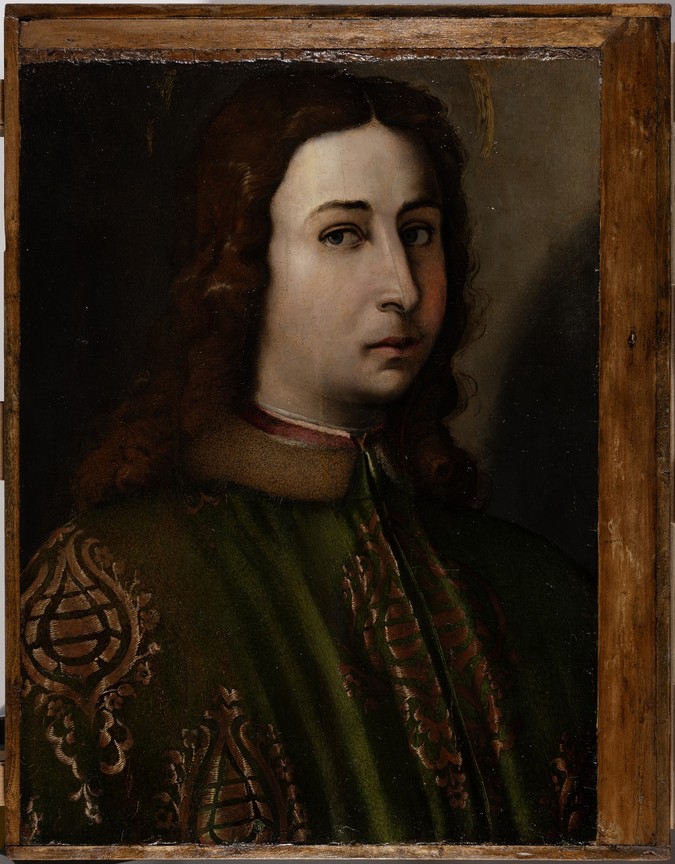
Abstract The present study, conducted for attributional purposes, proposes a technical-stylistic and iconographic reading of the Male Portrait of a Young Man on panel, based on diagnostic investigations and material analyses integrated with historical-artistic reflection. The multidisciplinary approach examines the support, preparation, painting technique, and conservation history in order to define chronology, area of production, and lines of attribution. Particular emphasis is placed on the presence and stratification of the halo, interpreted in light of analytical evidence and the Renaissance portraiture context. The study provides an organic framework of material and stylistic data, offering elements useful for placing the work within the context of Northern Italian portraiture between the late 15th and early 16th centuries and for evaluative attributions.
This study proposes a technical-stylistic and iconographic reading of the Male Portrait of a Young Man on Panel (oil on poplar, 53.3 × 41.9 cm, private collection), conducted with the aim of defining its chronology, area of production, authorship, and the possible identity of the subject. Through an integrated diagnostic protocol (IR reflectography at 1000/1700 nm, UV fluorescence, digital radiography, portable XRF, and optical microscopy on stratigraphic cross-sections), the execution technique, constructive sequence, and conservation state of the work have been reconstructed. The material data confirm the use of a single poplar panel, a thin gypsum preparation (0.05–0.09 mm) with an organic binder, and painting executed through superimposed glazes (0.02–0.04 mm) rich in pigments typical of the Padan-Venetian tradition from the late 15th to early 16th century: lead white, cinnabar, malachite with traces of arsenic, lead-tin yellow, and gilding. Stylistic and micro-morphological analysis of the brushwork (ductus), light management, and tonal plane construction places the work within the operational orbit of Jacopo Palma il Vecchio and his workshop.
The most innovative aspect of the research lies in the identification hypothesis of the subject as Giovanni Pico della Mirandola (1463–1494). Three levels of anatomo-morphological comparison (Giovian Series/Uffizi, Mirandola museum version, forensic reconstruction from the skull) show a structural compatibility ranging from 89% to 91%, supported by craniofacial, proportional, and iconographic correspondences. The presence of the halo, interpreted in light of diagnostic evidence and historical context, is read not as an attribute of canonical sanctity, but as a possible late "iconographic camouflage" or a moral sacralization in a Neoplatonic key, functional to the survival of the image of a heterodox intellectual. The study offers a comprehensive framework that unites materials science, art history, and image philology, contributing to the debate on Renaissance portraiture, the transmission of Pichian models, and attributional practices in Venetian-Lombard painting.
1. Introduction and Objectives
The Renaissance portrait was never a mere physiognomic record, but rather a device for identity construction, a status symbol, and a vehicle for philosophical values. In the absence of commissioning documents or autograph inscriptions, the attribution and identification of works such as this require a multidisciplinary approach integrating non-invasive diagnostics, stratigraphic analysis, stylistic comparison, and historical-iconographic reconstruction. This work stems from the need to place the Male Portrait of a Young Man within precise chronological and geographical coordinates, to evaluate its artistic authorship, and, above all, to verify the plausibility of identifying the subject with one of the most emblematic and controversial figures of Italian Humanism: Giovanni Pico della Mirandola.
2. Diagnostic Methodology
The technical-material characterization was conducted through:
Multispectral imaging: VIS, raking light, UV, IR 1000/1700 nm, false-color IR
Digital radiography: FPD 43×43 cm, 40 kV
Optical microscopy: stratigraphic cross-sections in visible and UV light (200x–400x)
Portable XRF spectrometry: Bruker Tracer 5g, 35 kV / 10 µA / 15s
Micro-morphological analysis: brush pressure, ductus, craquelure, functional asymmetries
These investigations enabled the decoding of the execution sequence, binder composition, chromatic stratigraphy, and traces of preparatory drawing/incisions, providing an objective basis for comparison with Venetian and Lombard workshop practices of the period.
3. Technical Data and Stylistic Attribution
The analyses confirm:
Support: single poplar panel (Populus sp.), consistent with central-northern Italian practices.
Preparation: thin gypsum (50–90 µm) with organic/lipidic binder, functioning as a "luminous field" for glazes.
Painting technique: construction through superimposed transparent glazes (0.02–0.04 mm), absence of heavy impastos, systematic use of structural lead white and cinnabar for flesh tones.
Preparatory drawing: contour incisions + localized carbonaceous brush traces, a mixed practice typical of Venetian workshops.
Pigments: malachite (with As), lead-tin yellow, earths, carbon black, gold in the halo.
Craquelure: fine, isotropic network on the face (high film elasticity), more pronounced and directional on the garment (higher material load), consistent with the progressive aging of poplar.
Stylistically, the tonal softness, volumetric construction through light/shadow, management of the operated velvet fabric, and the subject's courtly composure reveal strong affinities with the output of Palma il Vecchio (1480–1528). The technique reflects a synthesis between the Leonardesque tradition (sfumato, glazes, contour dissolution) and Venetian sensibility (luminous color, light preparation, material rendering of drapery), consistent with the period c. 1500–1520.
4. The Identification Hypothesis: Giovanni Pico della Mirandola
The proposal to identify the young man in the portrait as Giovanni Pico della Mirandola is based on three converging lines of inquiry: morphological-compatibility, iconographic-historical, and contextual-philosophical.
4.1 Anatomo-Morphological Comparisons Three comparative verifications were conducted with known prototypes and reconstructions:
Giovian Series (Cristofano dell'Altissimo, Uffizi): 89.7% physiognomic compatibility, despite differences in framing (profile vs. 3/4). Correspondence in the elongated oval structure, aristocratic straight-bridged nose, thin lips, non-prominent chin, and wavy chestnut hair.
Mirandola Civic Museum version (Ferri line): 89% compatibility. Near-perfect alignment in nasal profile, eyebrow arch, elliptical eye shape, and craniofacial proportion.
Forensic reconstruction from Pico’s skull: estimated reliability between 88% and 91%. Dolichocephaly, high nasal root, slight dorsal convexity, and occipital region conformation structurally correspond to the painted volumes. The skeletal reconstruction, free from pictorial stylization, provides an objective anatomical reference of exceptional relevance.
4.2 Iconographic Context and Model Transmission Pico died prematurely in 1494.
His iconography survived through copies, reworkings, and local models (e.g., Medici series, Ferrarese/Mirandolese versions). The presence of an 18th-century portrait by Antonio Ferri, explicitly labeled as Pico and lacking a halo, suggests the existence of an earlier prototype, likely 15th/16th-century, from which later versions derive. The work under examination, through its composition, proportions, and psychological rendering, fits perfectly into this transmission line, likely stylistically updated to the Venetian tonal language of the early 16th century.
4.3 Historical Plausibility and Cultural Network Palma il Vecchio operated in Venice from c. 1510, frequenting the same patrician and collecting circles (Contarini, Marcello, Vendramin) where Pichian-inspired texts and portraits circulated. Gianfrancesco Pico della Mirandola, nephew and curator of his uncle’s legacy, was active between Mirandola, Ferrara, Mantua, and Venice until 1533, weaving networks with humanists and patrons linked to Palma’s circle. In this context, the commissioning (or reworking) of a posthumous portrait of Giovanni Pico, filtered through the Neoplatonic ideal of intelligible beauty and moral composure, is historically plausible and consistent with the intellectual self-representation practices of the era.
5. The Role of the Halo: Sacralization, Iconographic Camouflage, and Image Survival
The golden halo, revealed through cleaning interventions and confirmed by XRF as precious metal, is not part of the original conception. IR and UV investigations reveal:
Absence of carbonaceous preparatory drawing in the halo zone.
Regular central interruption, compatible with mechanical removal or ancient cleaning.
Application in a subsequent phase, likely antique.
In light of the historical context, the halo should not be read as an attribute of canonical sanctity, but as a device for iconographic protection. In an era when Pico’s thought faced ecclesiastical condemnation and his figure was perceived as "uncomfortable", transforming a philosophical-aristocratic portrait into an apparently devotional image could have guaranteed the work’s survival against censorship. The halo thus functions as a visual bulwark: it does not celebrate sanctity, but masks the identity to preserve it, fitting into a well-documented practice of iconographic adaptation in the Italian Renaissance.
6. Conclusions and Research Perspectives
The convergence of material data, execution technique, compositional style, and morphometric compatibility places the painting within the transitional Venetian-Lombard figurative culture (late 15th–early 16th century), attributable to Palma il Vecchio or his workshop circle. The identification hypothesis with Giovanni Pico della Mirandola is not based on literary suggestions, but on:
· Anatomo-morphological correspondences (89–91%)
· Iconographic consistency with Pichian transmission
· Historical plausibility of the Venetian/Padan context
· Symbolic function of the halo interpreted as a cultural survival strategy
The portrait thus emerges as a visual document of exceptional interest: testimony to a refined technical practice, a Venetian-Leonardesque stylistic sensibility, and, above all, how Renaissance art managed to transfigure the image of the intellectual into a Neoplatonic ideal, preserving his memory through the language of painting.
© 2026 Di Maria A., Chiarabini A. This work is licensed under a Creative Commons Attribution 4.0 International License (CC BY 4.0). You are free to share, copy, distribute and adapt the material for any purpose, including commercially, provided that appropriate credit is given to the authors, a link to the license is provided, and any changes are indicated. Suggested citation: Di Maria, A., & Chiarabini, A. (2026). Male Portrait of a Young Man on Panel: Technical-Stylistic Investigation and Attributional Purposes. https://doi.org/10.31219/osf.io/26cmk
References
C. J. Ball, Imaging and Analysis for Cultural Heritage, Routledge, 2018.
R. L. Feller, Conservation of Paintings, Getty Publications, 2016.
M. T. Ashley, “Reflectance Transformation Imaging (RTI) for Cultural Heritage,” Journal of Cultural Heritage, 2019.
P. Smith, Photographic Documentation of Works of Art, Focal Press, 2017.
J. Delaney et al., “Multispectral Imaging in Art Conservation,” Studies in Conservation, 2015.
Roy, Light and Perception in Painting, University Press, 2014.
S. Henderson, “Color Calibration and Reproduction,” Imaging Science Journal, 2018.
G. Thompson, Chiaroscuro and the Baroque Portrait, Academic Press, 2012.
2023 - Focus Cultura e Storia, “Pico della Mirandola: il genio che faceva paura ai poteri forti,”
B. Berenson, Pitture italiane del Rinascimento: catalogo dei principali artisti e delle loro opere, revised edition, Milan, 1936, p. 515, as Alvise Vivarini.
B. Berenson, Quadri italiani del Rinascimento: un elenco dei principali artisti e delle loro opere, Venetian School, London, 1957, I, p. 195, plate 341, as Alvise Vivarini.
Palma il vecchio. lo sguardo della bellezza, chapters from homonymous catalog, Milan, Skira, 2015. Renzo Villa
Archivio di Stato di Venezia, Cancelleria Inferiore, Miscellanea molai diversi, b. 34, fasc. "Inventario de li beni del quondam ser Iacopo Interiore, Miscellanea molai diversi, b. 34, fasc. "Inventario de li beni del quondam ser Iacopo Palma c. 1 v e c. 2r
Giovanni Mariacher, Palma il Vecchio, in I pittori bergamaschi-Il Cinquecento, I, Bergamo, Poligrafiche Bolis, 1975.
Philip Rylands, Palma il Vecchio, L'opera completa, Milan, Arnoldo Mondadori Editore S.p.A., 1988, ISBN 880430246-1
Iacopo Palma e la moda italiana del Rinascimento, Bergamo, Grafica e Arte, 2015, ISBN 978-88-7201-338-0.
P. Pino, Dialogo di pittura (1548), edited by R. Pallucchini - A. Pallucchini, Venice 1946, pp. 74, 128, 153
G. Vasari, Le vite (1550 and 1568), edited by R. Bettarini - P. Barocchi, IV, Florence 1976, pp. 549-556
E. Fornoni, Notizie biografiche su Jacopo Palma Vecchio, Bergamo 1886;
V. Mikelli, Di Jacopo Palma il Vecchio e dell’arte contemporanea, in Atti della R. Acc. di belle arti di Venezia, 1874, pp. 3-57
M. Boschini, La carta del navegar pitoresco (1660), edited by A. Pallucchini, Venice 1966, pp. 4, 175
L. Dolce, Dialogo della pittura… (1557), in Trattati d’arte del Cinquecento, edited by P. Barocchi, I, Bari 1960, pp. 141-206
G.P. Lomazzo, Trattato dell’arte…(1584), in Scritti sulle arti, II, edited by R.P. Ciardi, Florence 1974, p. 329
C. Ridolfi, Le maraviglie dell’arte (1648), edited by D. von Hadeln, I, Berlin 1914, pp. 115, 137-141
Palma il Vecchio. The Gaze of Beauty: chapters from the eponymous catalogue, Milan, Skira, 2015. Di Renzo Villa
A.M. Zanetti, Della pittura veneziana, III, Venice 1771, pp. 92 s., 203-207, 306, 311
Documents for download
Stats
- Recommendations n/a n/a positive of 0 vote(s)
- Views 294
- Comments 0