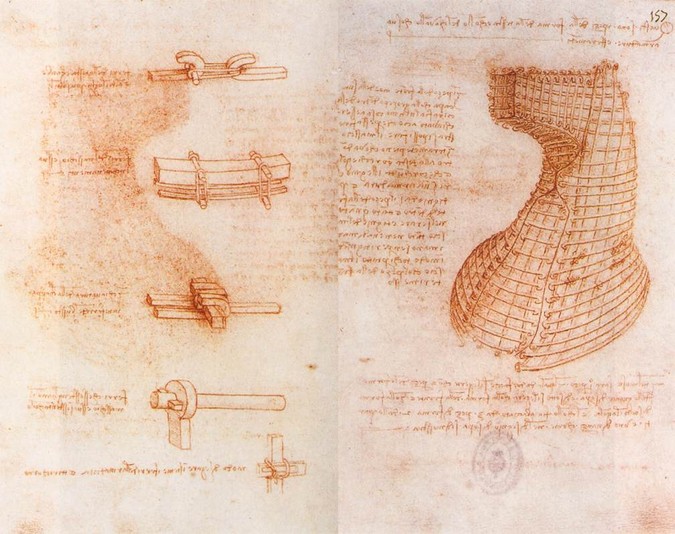
In the Madrid Codex II, preserved at the Biblioteca Nacional de España, Leonardo da Vinci records a brief yet remarkably significant reflection on wood preservation, describing a specific treatment technique aimed at making it resistant to degrading agents. This short note, seemingly marginal compared to the grand themes of mechanics or hydraulics that permeate the codex, actually reveals a profound awareness of the organic behavior of materials and an early intuition of what, centuries later, would be defined as “bioarchitecture.” The aim of this study is to analyze this annotation in light of Leonardo’s technical-scientific thought, the Renaissance cultural context, and the contemporary rediscovery of its experimental value. Through a comparative approach between Leonardo’s manuscript sources, contemporary treatises, and modern studies on the behavior of lignocellulosic materials, we intend to demonstrate how Leonardo understood the need to integrate science, nature, and sustainability long before these concepts were formulated in the language of modernity. His reflection on the “life of wood” emerges as a paradigm of systemic thinking ante litteram, capable of combining empiricism and natural philosophy.
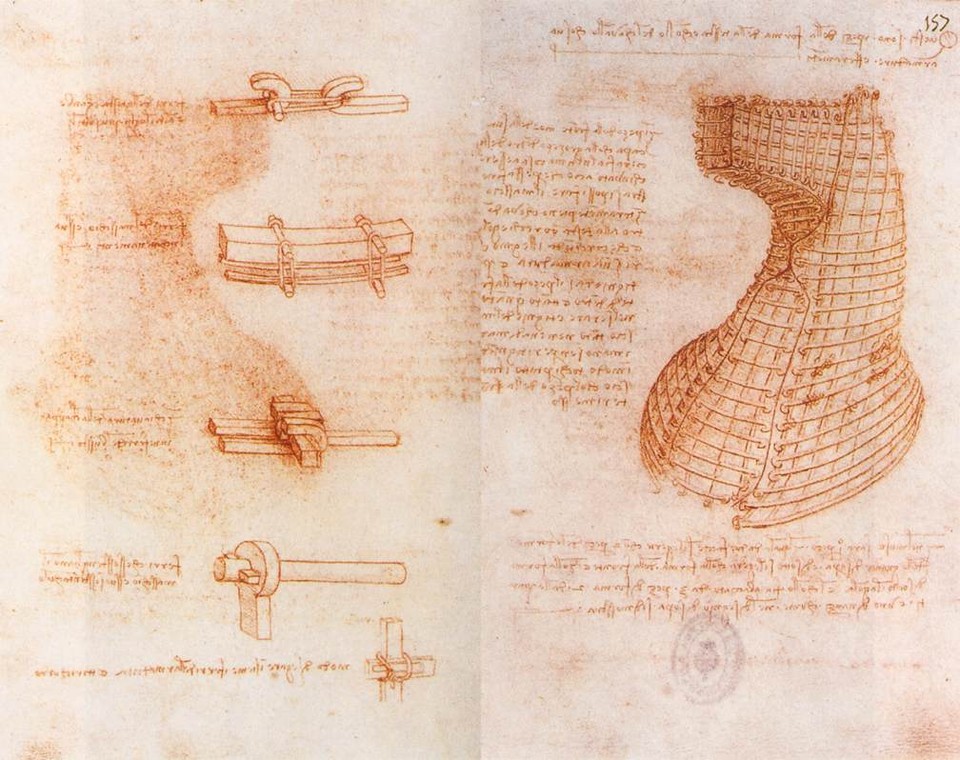 Image 1
 Introduzione
Tra le molteplici sfaccettature dell'opera di Leonardo da Vinci, l'attenzione per i materiali naturali occupa un posto centrale. Il legno, in particolare, rappresenta per Leonardo non solo un materiale da costruzione, ma un organismo vivente, un sistema in equilibrio con il suo ambiente. Nel Codice di Madrid II, scritto tra la fine del XV e l'inizio del XVI secolo durante il suo periodo milanese, Leonardo annota una sua ricerca empirica su un metodo per proteggere il legno e garantirne la durabilità nel tempo. Questa nota, apparentemente tecnica, si inserisce in una prospettiva più ampia: Leonardo osserva, analizza e sperimenta la resistenza dei materiali organici, applicando principi che oggi definiamo "ecocompatibili". Il suo interesse non si limita all'efficacia meccanica, ma si estende al rapporto tra materia e ambiente, tra processi naturali e intervento umano. Comprende che ogni materiale, per essere veramente funzionale, deve essere trattato secondo la sua "natura intrinseca", rispettando quella che oggi chiameremmo la "sostenibilità intrinseca" del materiale stesso.
Come evidenziato da diverse fonti storiche e divulgative, e attraverso un esame diretto del manoscritto, Leonardo annota nel Codice di Madrid II una tecnica oggi particolarmente diffusa nella cultura giapponese per la protezione del legno mediante una carbonizzazione controllata della superficie. Questa procedura è sorprendentemente simile a quella che oggi conosciamo come Yakisugi . L'annotazione non è un caso isolato. In altre parti dei suoi manoscritti, Leonardo riflette sul comportamento della materia vegetale, sulla traspirazione del legno, sulla sua capacità di assorbire e rilasciare umidità e sulle trasformazioni chimico-fisiche che ne modificano la consistenza nel tempo. Questa attenzione alla "vita della materia" si allinea con la sua visione del mondo come organismo dinamico, in cui le leggi della natura si ripetono sia a livello micro che macrocosmico. Da una prospettiva storica, l'annotazione appare in un momento cruciale per la cultura materiale europea. Tra il XV e il XVI secolo, la lavorazione del legno stava ricevendo rinnovata attenzione nelle botteghe artistiche e negli studi di ingegneria civile. Leonardo, immerso in questo fervore tecnico, eleva il tema del legno a oggetto di studio teorico, interpretandolo attraverso una lente interdisciplinare che unisce arte, scienza e filosofia naturale. La riscoperta moderna di questa annotazione non è una mera curiosità filologica: restituisce a Leonardo l'immagine di un precursore della cultura ecologica e sostenibile, un pensatore che anticipa l'idea moderna di "materiali intelligenti", non passivi, ma reattivi all'ambiente circostante.
2. Analisi della nota nel Codice di Madrid II: interpretazione filologica e implicazioni tecniche
La breve annotazione di Leonardo da Vinci nel Codice di Madrid II — "Si conserveranno meglio se scortecciati e carbonizzati superficialmente che in qualsiasi altro modo" — è uno dei frammenti più densi e rivelatori del suo pensiero tecnico e scientifico. In poche parole, Leonardo esprime un principio di sorprendente modernità: la protezione del legno attraverso una carbonizzazione superficiale controllata, un metodo che prolunga la durata del materiale modificandone la struttura esterna senza alterarne le proprietà meccaniche.
2.1. Interpretazione filologica del testo
Dal punto di vista linguistico, la frase è caratterizzata da una sintassi prescrittiva e sperimentale. Il verbo “sarà conservato” suggerisce una generalizzazione empirica: Leonardo non propone un'ipotesi, ma enuncia una regola derivata dall'osservazione diretta. La locuzione “scorticato e carbonizzato superficialmente” definisce due operazioni successive e complementari: la rimozione della corteccia e la carbonizzazione della superficie. La prima elimina lo strato biologicamente attivo, soggetto a decomposizione e infestazione da parte di insetti xilofagi; la seconda crea una barriera protettiva di carbonio. Il verbo “carbonizzare”, nella tipica ortografia leonardesca, non implica distruzione ma un processo di esposizione controllata al fuoco, una testimonianza della sua metodologia sperimentale basata sulla regolazione dei fenomeni naturali. Infine, la proposizione comparativa “che in qualsiasi altro modo” esprime una convinzione assoluta, quasi dogmatica: nessun altro procedimento, secondo Leonardo, è più efficace nella conservazione del legno. Così, in una sola frase, Leonardo condensa un'intera teoria empirica sulla stabilità dei materiali organici.
2.2. Contesto tecnico e sperimentale della Nota
The annotation is part of the technical reflections in the Madrid Codex II, which includes studies on mechanics, civil engineering, and construction materials. Leonardo consistently shows interest in the structural properties of natural materials—stone, metal, wood—observing them through the eyes of both artist and engineer. In the specific case of wood, the recommendation to debark and superficially char it responds to precise physical observations. Through direct experience in workshops and construction sites, Leonardo had noticed that raw wood left with its bark tended to retain moisture and decay more quickly. By removing this layer and lightly “charring” the surface, the material stabilizes: the carbonized layer creates a hydrophobic and biocidal film that prevents water penetration and microbial proliferation. This principle—now fully validated by materials science—corresponds to the phenomenon of surface carbonization, or “partial pyrolysis,” whereby the hemicellulosic and lignin components of wood thermally degrade to form a compact layer of amorphous carbon. This layer drastically reduces wood permeability, increasing its resistance to atmospheric and biological agents. Leonardo’s intuition anticipates the Eastern technique known as Shō Sugi Ban (Yakisugi), traditionally used in Japan to protect cedar wood.
2.3. Epistemological Significance: From Empirical Gesture to Theory of Matter
Leonardo’s sentence should not be interpreted as a mere technical tip, but as the manifestation of a theory of living matter. He considers wood not as inert material, but as a body that “lives and breathes,” subject to the same laws of birth, transformation, and decay that govern all natural organisms. The practice of “charring” thus becomes an act of controlled transmutation, through which humans intervene in the material’s life cycle to grant it a form of survival. In other words, Leonardo does not destroy the wood, but “fixes its life” in a state of thermodynamic equilibrium. Viewed from this perspective, the annotation reveals the deep connection between experiment and natural philosophy in Leonardo’s thought. Knowledge arises from observing nature’s spontaneous processes, which humans can imitate and accelerate without violating its laws. Fire, the quintessential element of transformation, is interpreted not as a destructive force but as a tool of regeneration—a “cognitive flame” that enables understanding and reproduction of matter’s vital processes. Leonardo applies this same logic to many other materials—metals, pigments, stones—conceiving every transformation as a passage from an unstable state to a more perfect one. Charred wood is an emblematic example: fire, when used with measure, does not take life from matter but preserves it in the most stable form of its being.
2.4. Interpretive Conclusion
The phrase “They will be better preserved if debarked and superficially charred than in any other way” thus encapsulates a dual dimension:
- A technical-experimental dimension, anticipating wood protection methods still in use today and based on principles of materials chemistry;
- A philosophical-naturalistic dimension, in which matter’s transformation becomes an act of knowledge and a manifestation of harmony between humans and nature.
3. Leonardo and the Philosophy of Matter: From Wood to Renaissance Bioarchitecture
3.1. Premise: Leonardo as an Observer of Materials
The brief yet meaningful annotation found in the Madrid Codex II—“They will be better preserved if debarked and superficially charred than in any other way”—succinctly conveys Leonardo’s epistemological stance toward matter: he does not view materials as passive entities to be exploited, but as dynamic systems whose durability depends on technical knowledge that respects their internal nature. This perspective positions the Florentine genius as a precursor to what we now call “bioarchitectural” practice: human intervention on materials must be calibrated to an understanding of their biological and physical properties.
3.2. Chronology and Priority: Leonardo and the Japanese Practice of Shō Sugi Ban
A key element in understanding the historical significance of the note is the chronological precedence between Leonardo’s statement and the codification of the Japanese technique known as Shō Sugi Ban or Yakisugi. The Madrid manuscripts date approximately to the late 15th–early 16th century; documentary evidence of wood charring in Japanese tradition becomes consolidated only in the modern era (17th–18th century), with a distinct cultural and aesthetic codification in Japanese architecture. Therefore, as studies suggest, Leonardo’s formulation predates the Japanese practice (and its nationalization): from this standpoint, the note cannot be read as emulation but as an autonomous anticipation. This chronological factor is crucial to how we interpret the statement: it is not a demonstrable intercultural derivation (there is currently no evidence of direct technical transfer from Asia to Leonardo), but rather a case of convergent invention—a solution independently arrived at for a universal technical problem: how to improve wood’s resistance to atmospheric and biological agents.
3.3. Convergence of Empirical Intuition and Theoretical Awareness
The strength of Leonardo’s phrase lies in its dual register: practical and theoretical. On a practical level, Leonardo outlines a two-step procedure—removal of bark; surface treatment with fire—that responds to recurring empirical observations in workshops and construction sites. On a theoretical level, he formulates a general rule of comparative effectiveness: the “charred” treatment, in his view, surpasses all other available methods. This dual value is the hallmark of his experimental method: repeated observation gives rise to a rule that, though expressed succinctly, carries prescriptive weight.
3.4. The Problem of Modern Explanations: Experimental Evidence as Framework, Not Historical Judgment
In discussing the scope of Leonardo’s intuition, it is useful to distinguish between two levels of interpretation: the historical-philological level—which assesses the significance of the statement within Renaissance thought—and the modern-experimental level—which measures the technical effectiveness of the process through controlled testing. While the former dimension recognizes Leonardo as a theoretical and methodological forerunner, the latter requires scientific protocols to validate the practical efficacy of surface carbonization under varying conditions.
The relationship between these two perspectives has recently been explored in scientific studies examining the behavior of charred wood (for a concise reference to experimental literature, see Hasburgh et al., 2021). These studies confirm that surface carbonization can produce protective effects, while noting that such effects depend on wood species, operational parameters, and environmental conditions. Nevertheless, their findings do not diminish the historical importance of Leonardo’s insight: the phrase demonstrates his ability to infer, from qualitative observations, material properties that modern experimental science would later quantify and define.
3.5. Conceptual Priority: Leonardo as Independent Forerunner
Based on historical findings and the chronological sequence of documentation, it is reasonable to assert that Leonardo independently formulated a principle which, although developed and codified centuries later in Japan, follows the same technical-functional logic: transforming the wood’s surface with heat to enhance its durability. In terms of the history of techniques, this represents a classic case of local anticipation: an empirical observation systematized by an observer with method and capacity for generalization.
For this reason, historical reconstruction should emphasize not a relationship of cultural derivation, but rather Leonardo’s conceptual and chronological priority: he formulates, in the heart of the European Renaissance, a wood treatment strategy whose practical validity would later be recognized and reused—independently—in other technical traditions.
3.6. Summary
The main lesson from analyzing the note is twofold: on one hand, Leonardo emerges as an observer and theorist of matter capable of generalizing from empirical experiences; on the other, chronology and context show that his intuition is autonomous from the later Japanese practice. Rather than saying “Leonardo copied the Japanese,” it is more accurate to say that Leonardo anticipated—and, retrospectively, other technical traditions arrived at conceptually similar solutions.
4. Conclusions
Leonardo’s statement—“They will be better preserved if debarked and superficially charred than in any other way”—represents not only a technical insight but a true theory of living matter. In this brief remark, Leonardo da Vinci synthesizes years of observation, experimentation, and reflection on wood—a living material, subject to decay, yet potentially stabilizable through calibrated intervention.
The analysis conducted in this study has shown that:
- The annotation is situated within the technical-material context of the Madrid Codex II, a collection of writings and drawings documenting Leonardo’s interest in materials and construction processes ([bibliotecadileonardo.museogalileo.it]).
- From a philological standpoint, the note adopts a prescriptive form (“they will be better preserved…”) that indicates a generalized empirical rule, distinct from mere occasional observations; it defines a method combining bark removal and controlled surface carbonization.
- From a historical-chronological perspective, Leonardo precedes the codification of the Japanese technique of Shō Sugi Ban (or Yakisugi) by over a century, and there is no evidence of direct contact between Renaissance European culture and Japanese building practices regarding this method. In this sense, his is an autonomous anticipation.
- The transformation of wood suggested by the note—bark removal; superficial exposure to fire—anticipates modern concepts in materials science and bioarchitecture: waterproofing, biological barriers, chemical-physical stabilization of wood surfaces.
The contemporary relevance of the annotation lies in showing that for Leonardo, wood was not merely a building material, but a subject of systematic study, and that the durability of materials depended not only on construction quality but on the relationship between matter, environment, and human intervention.
From a methodological standpoint, the case illustrated invites scholars of the history of techniques and materials to pay closer attention to “minor” annotations in Renaissance manuscripts: they often conceal technical and material principles that would only later be operationally codified. In Leonardo’s case, the transformation of wood becomes a paradigm of thought that unites art, science, nature, and technique.
Infine, questa ricerca propone una reinterpretazione di Leonardo non solo come inventore o pittore, ma come precursore della sostenibilità: il primo in Europa a suggerire una tecnica di protezione del legno oggi considerata "eco-edilizia". Le sue osservazioni osservano la strada a una lettura della tecnologia rinascimentale come laboratorio di soluzioni materiali che conservano ancora la loro rilevanza nel XXI secolo.
Cover image: Leonardo da Vinci, Double manuscript page on the Sforza monument, c.1493. Red chalk on paper, 21 × 30 cm. Biblioteca Nacional de España, Madrid. Immagine: Wikimedia Commons, Public Domain Mark.
References
Bibliografia
Di Maria, A., Da Montefeltro, A., Bianchi, L. (2025). Leonardo e il segreto del legno indistruttibile: la tecnica rinascimentale che rivoluziona la bioarchitettura. https://doi.org/10.5281/zenodo.17506250
Malito, A. (2025, 16 settembre). Leonardo da Vinci, il visionario che bruciò la legna (per salvarla). La Voce agli Italiani. Estratto da https://www.lavoceaglitaliani.it/site/index.php/arte-cultura/4386-leonardo-da-vinci-il-visionario-che-bruciava-il-legno-per-salvarlo
Museo Galilei. (nd). Codice di Madrid II. Biblioteca Digitale Leonardo. Estratto da https://bibliotecadileonardo.museogalileo.it/index.php/esplora/albero/codici/68589/68676
Hasburgh, LE, Zelinka, SL, Bishell, AB e Kirker, GT (2021). Durabilità e prestazioni antincendio del rivestimento in legno carbonizzato (Shō Sugi Ban). Foreste, 12(9), 1262. https://doi.org/10.3390/f12091262
Contributori di Wikipedia. (2024). Codice di Madrid II. SuWikipedia. Estratto da https://it.wikipedia.org/wiki/Codice_di_Madrid_II
Kilian, T. (2014). Shou-Sugi-Ban. Progettazione del legno. Costruzione, 66, 42–44.
Miller, H. (2016). Artigianato giapponese del legno. Rapporto finale della Winston Churchill Memorial Fellowship; Hugh Miller Furniture Company: Liverpool, Regno Unito. Disponibile online: https://www.hughmillerfurniture.co.uk/blog/japanese-wood-craftsmanship/
Hein, C. (2010). Dare forma a Tokyo: pratiche di sviluppo e pianificazione territoriale nelle metropoli giapponesi della prima età moderna. Giornale di storia urbana, 36, 447–484.
Graham, RD (1952). Durata di servizio dei pali di recinzione trattati e non trattati: Rapporto sullo stato di avanzamento del 1952 presso l'azienda agricola TJ Starker. Laboratorio dei prodotti forestali dell'Oregon: Corvallis, OR, USA.
White, RH e Dietenberger, MA (2010). Manuale del legno, Capitolo 18: Sicurezza antincendio delle costruzioni in legno. Dipartimento dell'Agricoltura degli Stati Uniti: Madison, WI, USA.
Friquin, Kuala Lumpur (2010). Tassi di carbonizzazione di strutture in legno massiccio per la progettazione della sicurezza antincendio. Tesi di dottorato, Università norvegese di scienza e tecnologia, Trondheim, Norvegia. Disponibile online: https://ntnuopen.ntnu.no/ntnu-xmlui/bitstream/handle/11250/231578/357755_FULLTEXT02.pdf?sequence=1
Schaffer, EL (1967). Tassi di carbonizzazione di legni selezionati - Attraverso la venatura. Documento DTIC: Madison, WI, USA. Disponibile online: https://www.fpl.fs.fed.us/documnts/fplrp/fplrp69.pdf
White, RH (1988). Tassi di carbonizzazione di varie specie legnose. Tesi di dottorato, Università del Wisconsin-Madison, Madison, WI, USA.
White, RH, & Nordheim, EV (1992). Tassi di carbonizzazione del legno per esposizione ASTM E 119. Fire Technology, 28, 5–30.
White, R. H., & Tran, H. C. (1996). Charring Rates of Wood Exposed to Constant Heat Flux. In Wood and Fire Safety: 3rd International Scientific Conference: Proceedings, Zvolen, Slovakia, May 6–9, 1996; Technical University of Zvolen, Faculty of Wood Technology: Zvolen, Slovakia; pp. 175–183. Available online: https://www.fs.usda.gov/treesearch/pubs/5978
Bartlett, A. I., Hadden, R. M., & Bisby, L. A. (2019). A Review of Factors Influencing Wood Combustion Behavior for Tall Timber Construction. Fire Technology, 55, 1–49.
Schaffer, E. L. (1966). Review of Information Related to Wood Charring Rates. Forest Products Laboratory: Madison, WI, USA; Volume 145.
Janssens, M. L., & White, R. H. (1994). Brief Communication: Temperature Profiles in Wood Elements Exposed to Fire. Fire and Materials, 18, 263–265.
Bartlett, A., Hadden, R., Bisby, L., & Law, A. (2015). Analysis of Charring Rates of Cross-Laminated Timber Under Non-Standard Heating Conditions. Fire and Materials, pp. 661–687. Available online: http://www.intersciencecomms.co.uk/html/conferences/fm/fm15/fm15.htm
Fortini, A. P. (2017, September 19). Shou Sugi Ban: Black and Burned Wood. The New York Times Style Magazine. Available online: https://digitalscholarship.unlv.edu/english_fac_articles/149/
Hill, C. A. (2007). Wood Modification: Chemical, Thermal and Other Processes; John Wiley & Sons: Chichester, UK; Volume 5.
Tjeerdsma, B., Boonstra, M., Pizzi, A., Tekely, P., & Militz, H. (1998). Characterization of Thermally Modified Wood: Molecular Reasons for Improved Performance. Holz Als Roh-Und Werkst, 56, 149.
Militz, H., & Altgen, M. (2014). Processes and Properties of Thermally Modified Wood Produced in Europe. In Deterioration and Protection of Sustainable Biomaterials; ACS Publications: Washington, DC, USA; pp. 269–285.
Candelier, K., Thevenon, M.-F., Petrissans, A., Dumarcay, S., Gerardin, P., & Petrissans, M. (2016). Control of Thermal Treatment of Wood and Its Effects on Decay Resistance: A Review. Annals of Forest Science, 73, 571–583.
Čermák, P., Dejmal, A., Paschova, Z., Kymäläinen, M., Dömény, J., Brabec, M., Hess, D., & Rautkari, L. (2019). One-Sided Surface Charring of Beech Wood. Journal of Materials Science, 54, 9497–9506.
Kymäläinen, M., Turunen, H., Čermák, P., Hautamaki, S., & Rautkari, L. (2018). Moisture-Related Characteristics of Superficially Charred Spruce Wood. Materials, 11, 2083.
Kymäläinen, M., Hautamaki, S., Lillqvist, K., Segerholm, K., & Rautkari, L. (2017). Surface Modification of Solid Wood by Charring. Journal of Materials Science, 52, 6111–6119.
Kymäläinen, M., Turunen, H., & Rautkari, L. (2020). Effetto degli agenti atmosferici sui gruppi funzionali superficiali dei pannelli di rivestimento in abete rosso norvegese carbonizzato. Foreste, 11, 1373.
Machova, D., Oberle, A., Zárybnická, L., Dohnal, J., Seda, V., Dömény, J., Vacenovská, V., Kloiber, M., Pěnčík, J., & Tippner, J. (2021). Caratteristiche superficiali del legno di faggio carbonizzato su un lato. Polimeri, 13, 1551.
Akizuki, M., Hasemi, Y., Yasui, N., Kinoshita, K., Yammamoto, K., Yoshida, M., Tamura, Y., & Takeda, M. (2001). Studi sulla sicurezza antincendio nel restauro di una storica casa a schiera in legno a Kyoto: esperimenti sulla sicurezza antincendio negli edifici tradizionali giapponesi in legno. Scienza della sicurezza antincendio, 5, 329–340.
Stats
- Recommendations n/a n/a positive of 0 vote(s)
- Views 331
- Comments 0